.jpg)

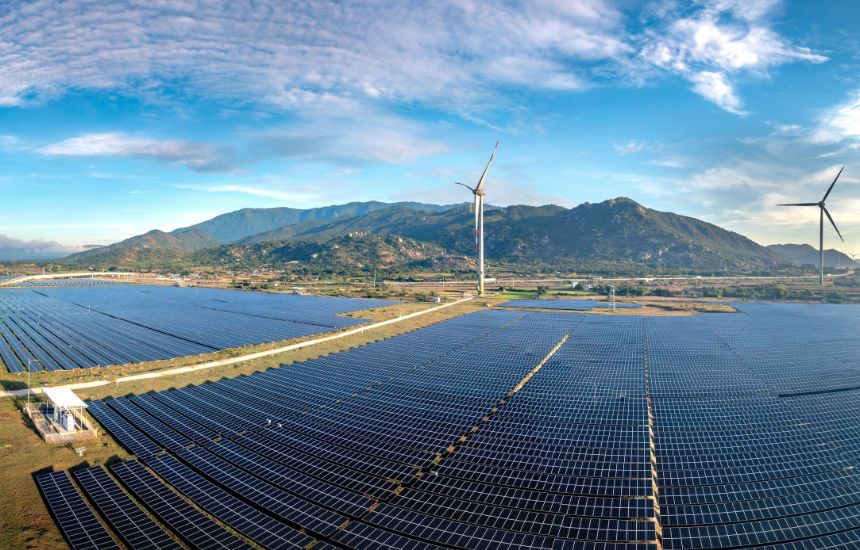
Ministry of New and Renewable Energy Secretary Santosh Kumar Sarangi has stressed the need for China-style super grid planning to support India’s long-term renewable energy ambitions and ensure efficient integration of clean power into the national grid.
Speaking at the Confederation of Indian Industry Annual Business Summit 2026, Sarangi said robust transmission infrastructure and coordinated energy planning will be critical for achieving the NITI Aayog target of 1,800 GW renewable energy capacity by 2050.
India is planning investments of nearly $574 billion by 2030 to develop a nationwide super grid network comprising high-voltage direct current (HVDC) and high-voltage alternating current (HVAC) transmission systems. The proposed infrastructure aims to efficiently transfer electricity from renewable energy-rich states to high-demand consumption centres across the country.
According to Sarangi, stronger transmission networks and improved grid planning are essential to reducing renewable energy curtailment and maximising utilisation of solar and wind assets. India has witnessed increasing renewable power curtailment in recent years, particularly in states with high solar and wind generation capacity.
The MNRE is also working on expanding the Green Energy Corridor programme with a larger financial outlay to strengthen interstate transmission systems and improve renewable energy evacuation infrastructure.
In addition to transmission expansion, the ministry is focusing on scaling up deployment of battery energy storage systems (BESS), grid-forming inverters, and advanced grid modernisation technologies to improve flexibility and stability within the power system.
Sarangi highlighted that close coordination between the central and state governments will be necessary to provide policy certainty for developers and investors while accelerating the country’s clean energy transition.
India’s renewable energy sector is undergoing rapid expansion, driven by ambitious net-zero goals, increasing power demand, and large-scale investments in solar, wind, storage, and green hydrogen infrastructure. Experts believe that without substantial grid modernisation and energy storage deployment, integrating future renewable capacity at scale will remain a major challenge.
.jpg)
.jpg)
.jpg)
.jpg)
-preview.webp)
-preview.webp)
-preview.webp)
-preview.webp)
-preview.webp)